What Is SA Mean in Text is a common question for people using online chats and social media. Many users ask “what does sa mean” when they see this short abbreviation in messages. The SA meaning can change depending on context, platform and conversation tone.
What Is SA Mean in Text can have different meanings in digital language. Some people use it as slang while others use SA as a formal acronym. The meaning of SA may connect with topics like Social Anxiety or other terms. Similar to BOU or WYW meaning in text, these abbreviations need context clues. Knowing how wa is used can also help you understand online conversations better.
What Is SA Mean in Text is explained by looking at real conversations and modern communication. This guide makes SA slang meaning simple and clear for everyone today.
SA Meaning in Text: Quick Answer
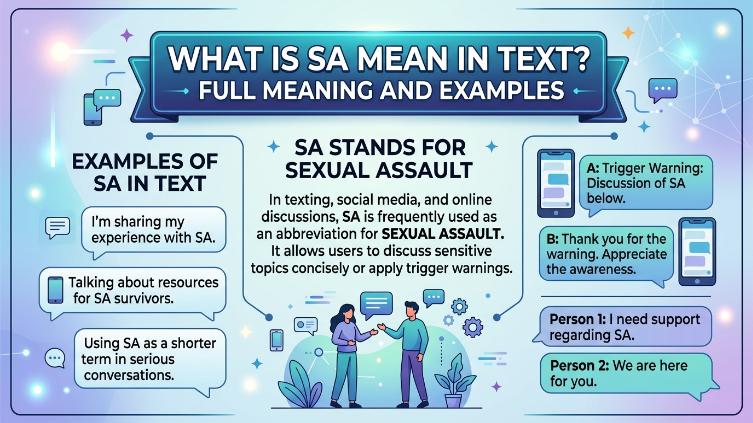
In texting and online conversations, SA meaning in text can have different meanings depending on the situation. The most common meanings include Social Anxiety, Sexual Assault, Sibling Alert, and South Africa.
The exact meaning of SA abbreviation depends on the conversation, platform, and context. A person using SA in a mental health discussion may mean Social Anxiety, while someone chatting with friends may use it as a casual slang term like Sibling Alert.
For example:
- “I skipped the event because of my SA.” → Social Anxiety
- “SA, my sister just entered my room.” → Sibling Alert
- “The post talks about SA awareness.” → Sexual Assault
Because SA is a common part of texting slang, internet slang, and social media abbreviations, you should always check the surrounding conversation before understanding its meaning.
Common Meanings of SA
The SA slang meaning changes based on where and how people use it. Unlike some text abbreviations that have one fixed meaning, SA works as a flexible acronym in different communities.
Here are the most common meanings of SA:
Social Anxiety:
People often use SA in mental health discussions to describe anxiety, nervousness, or discomfort in social situations.
Sexual Assault:
In awareness campaigns, educational topics, and sensitive conversations, SA is often used as a shorter way to discuss sexual assault.
Sibling Alert:
In casual conversations, especially among younger users, SA can mean a warning that a sibling is nearby.
South Africa:
SA is widely used as an abbreviation for the country in travel discussions, news, and online communities.
Situation Analysis:
Businesses and professionals use SA in planning, reports, and workplace discussions.
School Administrator:
In education settings, SA may refer to a school administrator who manages academic activities.
Stay Awesome:
Some users use SA as a friendly phrase in casual chats.
System Administrator:
In technology fields, SA may refer to a system administrator who handles computer systems and networks.
Student Affairs:
Universities and educators may use SA when discussing student services and academic support.
Since SA has multiple meanings, understanding the conversation tone is important. The same abbreviation can have a completely different meaning on WhatsApp, Instagram DMs, TikTok comments, or professional platforms.
Origin and Background of SA
Unlike many modern slang terms that become popular from a single social media platform, SA abbreviation developed through the growth of text abbreviations, internet slang, and digital language.
People started shortening common words and phrases to communicate faster through instant messaging and online chat. As messaging apps and social media platforms became more popular, abbreviations like SA became a normal part of online communication.
The SA full form depends on the community and topic where it appears. Mental health groups may use SA for Social Anxiety, awareness communities may use it for Sexual Assault, and casual conversations may use it as Sibling Alert.
Different online communities helped spread the use of SA over time:
- Mental health discussions often use SA when talking about anxiety and emotional challenges.
- Safety awareness campaigns use SA when discussing sexual assault awareness and survivor support.
- Teen and Gen Z slang culture uses SA in casual conversations and social media posts.
- Professional and educational fields use SA for terms like Situation Analysis, System Administrator, and Student Affairs.
Today, SA is part of global internet culture where users rely on context clues to understand abbreviations. Whether it appears on TikTok, Instagram, Reddit, X (Twitter), or WhatsApp, the meaning usually comes from the conversation, audience, and topic being discussed.
Real-Life Conversations
Seeing SA meaning in text through real conversations makes it easier to understand how people use this abbreviation in everyday communication. Since SA has multiple meanings, the surrounding words and conversation tone usually reveal the intended meaning.
People may use SA differently on messaging apps, social media platforms, and online communities. A friend might use it as casual slang, while another person may use it during a serious discussion.
Here are some realistic examples of how SA appears in conversations:
WhatsApp Example
Person A: Are you coming to the party tonight?
Person B: Probably not. My SA is making me feel uncomfortable around so many people.
Person A: That’s okay. Take your time.
Instagram DM Example
Person A: Why did you stop your live video?
Person B: SA 😂
Person A: Your sibling came in again?
Person B: Yep, every single time.
TikTok Comment Example
Person A: More people need to talk about SA awareness.
Person B: Absolutely. Education and support matter.
Text Message Example
Person A: How was your presentation today?
Person B: It went well, but my SA almost made me cancel.
These examples show that SA slang meaning changes with the situation. A funny conversation with friends may use SA as Sibling Alert, while a serious discussion may refer to Social Anxiety or Sexual Assault. Context helps people understand the real meaning behind the abbreviation.
Emotional and Psychological Meaning
The emotional meaning of SA in text depends on what the abbreviation represents in a conversation. When SA refers to Social Anxiety, it often connects with feelings like nervousness, fear, emotional discomfort, and self-awareness.
People may use SA to explain why they avoid social events, feel stressed in groups, or find certain situations challenging. For example, someone might text a friend:
“My SA is making me nervous about meeting new people.”
In this case, SA communicates a personal feeling without needing a long explanation. It helps people discuss mental health topics more easily during online conversations.
However, when SA refers to Sexual Assault, it carries a much more serious emotional meaning. People often use this abbreviation in awareness campaigns, support discussions, and sensitive conversations because the topic can involve trauma and vulnerability.
Using SA in these situations requires respectful communication. Conversations about sexual assault awareness, SA survivors, and survivor support should always consider empathy and understanding.
On the other hand, when SA means Sibling Alert, the emotional meaning is usually lighter. It may show humor, embarrassment, or playful frustration when someone’s sibling interrupts a private moment.
Because SA can represent very different experiences, understanding the psychological meaning requires looking at the context, conversation tone, and the people involved. Context helps create clearer and more respectful communication.
Usage in Different Contexts
The SA meaning in text changes depending on where and how people use it. In modern communication, the same abbreviation can have a casual meaning in one conversation and a serious meaning in another.
People use SA across social media, friendships, workplaces, and educational settings. Understanding the context helps you avoid misunderstandings and communicate more clearly.
Social Media
On platforms like TikTok, Instagram, Reddit, and X (Twitter), SA appears in different types of posts and discussions. Younger users often use it as part of Gen Z slang and social media language.
Examples:
- “My SA makes group events difficult.”
- “SA awareness needs more attention.”
- “SA, my brother is here again.”
The meaning depends on the post topic, comments, and overall conversation.
Friends and Relationships
In casual conversations, friends often use SA as a quick abbreviation. It can appear in funny messages, private chats, or everyday texting.
For example, someone might send “SA” to warn a friend that their sibling entered the room. In this situation, it creates humor and shows playful frustration.
However, friends may also use SA when discussing personal feelings like social anxiety. These conversations often require emotional support and understanding.
Work and Professional Settings
In professional communication, SA should be used carefully. Business emails, formal documents, academic papers, reports, and presentations usually need clear language.
For example, writing “SA” without explaining the meaning can confuse readers. In workplace training, business planning, or technology fields, SA may refer to terms like Situation Analysis, System Administrator, or Security Awareness.

Casual vs Serious Tone
The tone of the conversation plays an important role in understanding SA.
Casual meanings:
- Sibling Alert
- Stay Awesome
- Social media slang
Serious meanings:
- Social Anxiety
- Sexual Assault
- Security Awareness
Before responding to SA, consider the topic, audience, and conversation tone. A simple abbreviation can carry a completely different message depending on the situation.
When Not to Use It
Although SA meaning in text can be easy to understand in casual chats, there are situations where using this abbreviation may create confusion. Since SA has several meanings, choosing the wrong context can lead to misunderstandings.
When the topic is serious, professional, or sensitive, it is usually better to write the full phrase instead of using the SA abbreviation.
Formal Documents
Avoid using SA without explanation in:
- Business emails
- Academic papers
- Professional reports
- Presentations
- Workplace training materials
For example, writing “SA affects many people” in a report may confuse readers because they may not know whether it means Social Anxiety, Sexual Assault, or another term.
Sensitive Conversations
When discussing topics like Sexual Assault, mental health, trauma, or survivor support, clarity and respectful communication matter.
Using the full term can make conversations easier to understand and more supportive. Sensitive topics often involve people’s personal experiences, so avoiding unclear abbreviations helps create a safer discussion.
Cross-Cultural Communication
The meaning of SA can change across regions and communities. Someone from Western culture, Asian culture, or Middle Eastern culture may interpret the abbreviation differently.
In global internet culture, people from different backgrounds communicate through the same platforms. However, regional usage and language differences can affect interpretation.
Public Announcements
Public posts, educational content, and awareness messages should avoid unclear abbreviations. When sharing information with a large audience, spelling out the full meaning improves clarity.
Whether it appears on social media, online communities, or professional platforms, SA should always match the audience and situation. Clear communication prevents confusion and helps people understand the intended message.
Common Misunderstandings
Many people misunderstand the SA meaning in text because this abbreviation has several possible meanings. Unlike simple text abbreviations like IDK or BRB, SA does not always have one fixed definition.
The meaning depends on the conversation, platform, and context. Without checking the surrounding words, people can easily make the wrong interpretation.
Assuming Only One Meaning
One common mistake is believing that SA always means the same thing. Some users think it only refers to Social Anxiety, while others assume it always means Sexual Assault.
Both interpretations can be correct in certain situations. However, SA may also mean Sibling Alert, South Africa, Situation Analysis, or other terms.
Ignoring Context
Context clues are the key to understanding SA in online conversations. The topic, message tone, and people involved usually reveal the correct meaning.
For example:
- “My SA is getting worse before the events.” → Social Anxiety
- “SA, my sister is walking in.” → Sibling Alert
The same two letters can represent completely different ideas.
Tone Confusion
The tone of a message can change the meaning completely. A funny “SA” in a friend’s chat may show humor or playful frustration, while a serious discussion about SA awareness may involve sensitive topics.
Understanding conversation tone and audience awareness helps prevent mistakes when responding to abbreviations.
Generational Differences
Different age groups may understand SA differently. Gen Z slang and younger users often use abbreviations frequently in social media language and online chat.
Millennials and older users may recognize common meanings but may need more context when they see newer slang terms.
As digital communication continues to evolve, learning how abbreviations work helps everyone communicate better online.
Comparison Table
Since SA meaning in text can represent different ideas, comparing it with other common text abbreviations makes it easier to understand how these terms work in online communication.
| Abbreviation | Full Form | Meaning/Use | Tone | Common Usage |
| SA | Social Anxiety / Sexual Assault / Sibling Alert | Depends on context | Casual or Serious | Texting, social media, online conversations |
| IDK | I Don’t Know | Shows uncertainty or lack of information | Casual | Everyday chats and messaging apps |
| BRB | Be Right Back | Tells someone you will return soon | Informal | Instant messaging and online chat |
| IMO | In My Opinion | Shares a personal viewpoint | Casual | Discussions and social media posts |
| TBH | To Be Honest | Introduces an honest opinion | Friendly | Social conversations |
| FYI | For Your Information | Shares useful information | Neutral | Professional and casual communication |
| IRL | In Real Life | Refers to offline experiences | Casual | Social media and online communities |
Key Insight
Unlike abbreviations such as IDK, BRB, or FYI, which usually have one widely accepted meaning, the SA abbreviation is more flexible. Its meaning depends heavily on context clues, conversation tone, and the platform where it appears.
Before interpreting SA, always check the full message. A simple abbreviation can have a completely different meaning on WhatsApp, Instagram DMs, TikTok comments, or professional discussions.
Variations and Related Types of SA
The SA abbreviation has many meanings across different fields, communities, and conversations. While some meanings appear in casual texting and social media language, others belong to professional, educational, or serious discussions.
Here are the most common variations and related types of SA:
1. Social Anxiety
Social Anxiety is one of the most common meanings of SA in online conversations. People use it when discussing feelings of nervousness, fear, or emotional discomfort in social situations.
It often appears in mental health discussions where users talk about anxiety, self-awareness, and emotional support.
2. Sexual Assault
In serious conversations, SA can refer to Sexual Assault. This abbreviation often appears in awareness campaigns, legal discussions, educational topics, and support communities.
Because this is a sensitive topic, people should use respectful communication when discussing SA survivors and survivor support.
3. Sibling Alert
Among younger users, SA may mean Sibling Alert. This casual slang term warns someone that a sibling is nearby or has entered the room.
It is often used in funny conversations and creates a sense of humor, embarrassment, or playful frustration.
4. South Africa
SA is also a common abbreviation for South Africa. People use it in travel discussions, international social media, news, and online communities.
5. Situation Analysis
In business and professional settings, SA can mean Situation Analysis. Companies often use this term during planning, research, and business strategy discussions.
6. School Administrator
In education, SA may refer to a School Administrator. Schools, educators, and academic institutions may use this term when discussing management roles.
7. Stay Awesome
In casual chats, SA can stand for Stay Awesome. It is a friendly phrase used to encourage someone or end a conversation positively.
8. System Administrator
In technology fields, SA may refer to a System Administrator. This role involves managing computer systems, networks, and cybersecurity tasks.
9. Student Affairs
Universities often use SA for Student Affairs. This area focuses on student services, campus support, and academic communication.
10. Security Awareness
In workplace training and cybersecurity discussions, SA may stand for Security Awareness. Organizations use this term when teaching employees about online safety and digital risks.
Because SA appears in many areas, the correct meaning always depends on the topic, audience, and conversation context. Understanding these variations makes it easier to interpret SA in texting and online communication.
How to Respond When Someone Uses SA
Knowing the SA meaning in text is only the first step. The right response depends on what the person means and the tone of the conversation.
Before replying, check the context, topic, and relationship you have with that person. A casual message from a friend may need a funny response, while a serious discussion about mental health or Sexual Assault requires care and understanding.
Here are some ways to respond when someone uses SA:
Casual Replies
If SA means Sibling Alert or another casual slang term, you can reply in a simple and friendly way.
Examples:
- “Got it!”
- “Haha, that happens a lot.”
- “No worries.”
- “I understand.”
These replies work well in everyday chats with friends and family.
Funny Replies
When someone uses SA in a playful conversation, a humorous response can keep the chat light.
Examples:
- “Sibling alert activated!”
- “Time to disappear quickly 😂”
- “The timing is always perfect!”
- “Mission cancelled!”
Funny responses fit best when both people understand the joke and the conversation is casual.
Mature Replies
If SA refers to Social Anxiety, a supportive response can help the other person feel understood.
Examples:
- “Thank you for sharing that with me.”
- “I understand how difficult that can feel.”
- “Take your time. I’m here for you.”
- “You don’t have to handle it alone.”
Respectful Replies
When SA refers to Sexual Assault or other sensitive topics, respectful communication matters most.
Examples:
- “I’m sorry you’re dealing with this.”
- “Thank you for trusting me.”
- “I’m here if you want to talk.”
- “Your feelings are valid.”
The best way to respond to SA is by focusing on the person, not just the abbreviation. Understanding the situation helps create better conversations and stronger communication skills in online and real-life interactions.
Regional and Cultural Usage
The SA meaning in text can vary across different regions and cultures. As online communication continues to grow, abbreviations travel quickly through social media platforms and international communities.
People from different backgrounds may understand SA based on their language, experiences, and online habits. This is why context clues are important when interpreting abbreviations in global conversations.
Western Culture
In Western culture, especially in North America and Europe, SA often appears in mental health discussions, awareness campaigns, and online support communities.
Younger users may recognize SA as Social Anxiety when discussing emotional challenges or personal experiences. It may also appear in conversations about Sexual Assault awareness and survivor support.
Asian Culture
In Asian culture, the use of SA often depends on exposure to global internet trends and international social media.
Many users learn abbreviations through platforms like TikTok, Instagram, Reddit, and messaging apps. The meaning usually depends on the topic being discussed rather than local slang traditions.
Middle Eastern Culture
In Middle Eastern culture, SA is mostly recognized in English-speaking online communities. Users who interact with global platforms may see SA used in different ways.
Because online communication crosses borders, people often rely on conversation tone and context to understand the intended meaning.
Global Internet Usage
Today, SA is part of a wider global internet culture where abbreviations move between countries quickly. Social media platforms, online communities, and instant messaging have created a shared digital language.
TikTok, Instagram, Reddit, X (Twitter), and WhatsApp all contribute to the spread of modern abbreviations. However, regional usage still affects how people interpret slang terms.
Gen Z vs Millennials
Gen Z:
- More familiar with changing internet slang
- Uses social media abbreviations frequently
- Often understands meanings through context
Millennials:
- Recognize many common abbreviations
- May prefer clearer wording in professional settings
- Often use fewer newer slang terms
As language continues to evolve, understanding cultural differences helps people communicate more clearly. SA may look simple, but its meaning depends on the people, platform, and situation where it appears.
Is SA Safe for Kids?
The SA abbreviation itself is not harmful, but its meaning can change depending on the conversation. Since SA may refer to terms like Social Anxiety, Sexual Assault, Sibling Alert, or other phrases, children and teens need to understand the context before using or responding to it.
Some meanings of SA are completely casual. For example, Sibling Alert may appear in funny conversations between friends. However, other meanings involve sensitive topics, such as Sexual Assault or mental health discussions, which require careful and respectful communication.
Parents, teachers, and educators can help children develop online safety awareness by teaching them how to understand slang terms and ask questions when something seems unclear. Encouraging open conversations helps kids feel comfortable discussing confusing messages they see on social media platforms or messaging apps.
Children and teens should also learn that abbreviations can have different meanings in online communication. A message on TikTok, Instagram, or WhatsApp may not mean the same thing in every situation.
Teaching context awareness, respectful communication, and digital language skills helps young users navigate online conversations more safely. Understanding SA is not just about knowing the abbreviation; it is about knowing when a conversation needs caution, support, and clarity.
FAQ’s
What does SA mean in a text message?
SA can have different meanings depending on the conversation. It may refer to Social Anxiety, Sexual Assault, Sibling Alert, or other terms.
What does SA mean on TikTok?
On TikTok, SA meaning in text usually depends on the video topic. It can appear in mental health posts, awareness content, or casual comments.
Is SA a slang word?
SA can be a slang term in casual chats. Its meaning changes based on context, platform, and the people using it.
What is the full form of SA?
The SA full form varies by situation. Common meanings include Social Anxiety, South Africa, Sexual Assault, and Situation Analysis.
Why do people use SA in online chats?
People use SA because abbreviations make digital communication faster. This texting slang helps users share ideas quickly in conversations.
How can I understand the meaning of SA?
Look at the message context, tone, and topic. These clues help you understand the correct SA meaning in text.
Is SA safe for kids to use?
SA is not harmful by itself, but some meanings involve sensitive topics. Kids should learn context and ask questions when unsure.
Conclusion
If you are wondering What Is SA Mean in Text, the answer depends on the conversation and context. Many people search what does sa mean because this abbreviation has different uses online. The SA meaning can refer to Social Anxiety, Sexual Assault, Sibling Alert, or other terms.
Understanding What Is SA Mean in Text helps you avoid confusion while chatting on social media and messaging apps. Like BOU or WYW meaning in text, these short terms need context to understand their real purpose. Knowing how wa is used in a message can also help with digital conversations.
In the end, What Is SA Mean in Text becomes simple when you check the topic and tone. Context is the key to understanding modern online language.